We earn a commission if you buy through our links, at no extra cost to you.
Best Pressure Washer for House Siding (2026)
What the siding industry says about pressure washing a house, from PSI limits to tip choice and spray angle, plus five electric and gas models that fit.
At a glance
For house siding, pick a washer that can stay within 1,500 to 2,400 PSI and use a 40-degree tip. The EGO HPW3204-2 is cordless with adjustable modes, the Kärcher K 5 FC is a light 2000 PSI electric, and the Westinghouse WPX3200 is a gas option for large homes.
Washing a house is one of the most common reasons people buy a pressure washer, and one of the easiest ways to damage the house. Siding is a thin cladding with overlapping panels, and a strong stream aimed the wrong way can push water behind it. This guide sticks to what the siding industry and the machine makers actually say, then looks at five models from our ranking of the best pressure washers of 2026. If a point is not in a source we opened, we left it out.
We do not test products ourselves. The model specifications come from the manufacturers’ own pages and manuals. The siding advice comes from the Polymeric Exteriors Products Association (PEPA), the siding maker Ply Gem and the Simpson owner’s manual.
What the Siding Industry Says
Check with the Siding Maker First
PEPA’s cleaning and maintenance page says a power washer can be used on vinyl siding, “but with caution”, and says to always read the manufacturer’s instructions for both the siding and the power washer before you begin. It adds that some siding manufacturers do not recommend power washing, while others limit the pressure and the cleaners you can use. That makes your siding’s warranty and care sheet the first document to read. If you do not have it, ask the maker or the installer before you spray.
A Pressure Range and a Tip
Ply Gem’s instructions for cleaning vinyl siding recommend setting the washer between 1,500 PSI and a maximum of 2,400, using a 40-degree tip. That is one manufacturer’s guidance, not a rule for every siding product, but it gives a useful target. It also tells you which machines to look at first: a washer that tops out near 2,000 PSI sits inside the range, while a 3,200 PSI gas machine is above it.
Aim Level, Never Upward
PEPA says to hold the power washer straight at eye level and not to aim the stream upward, because that can force water behind the siding panels. Ply Gem says the same: hold it straight at eye level and do not aim upward, because water can collect behind the siding. Simpson’s manual also says to avoid driving water up behind siding.
One difference to know about: Simpson’s manual says to hold the wand at a 45-degree angle to the surface, while PEPA and Ply Gem say to hold it straight. We would follow the siding makers, since it is their product, and treat Simpson’s angle as general guidance from a machine maker.
Distance, Direction and Rinsing
Simpson’s manual gives three more rules for siding: keep the nozzle about 4 feet away from the siding to avoid damage, start washing at the bottom and work up, and then rinse from the top down. It adds that the further the nozzle is from the surface, the lower the pressure, and that using the wrong nozzle can damage surfaces.
Windows, Doors, Wiring and Plumbing
PEPA says to be cautious around windows, doors, electrical wiring and plumbing. That is a short list, but it covers the places where water does the most harm. Take care at corners, trim and any opening in the wall.
Detergent
Simpson’s manual lists a black nozzle that applies cleaning solutions and says to verify that a solution is compatible with the surface. It says never to use bleach, and to work in small areas so the soap does not dry. PEPA says some siding makers limit the cleaners you can use, which is another reason to check the siding care sheet.
Choosing the Nozzle
Simpson’s nozzle table lists the white 40-degree nozzle for painted or delicate surfaces, including vinyl and painted siding, and the green nozzle for standard cleaning, including unpainted siding, stucco and gutters. The red 0-degree tip is for hard, unpainted surfaces, and the manual says not to use it on wood. A 40-degree tip is the safe default on a house, and it is the one Ply Gem names.
People, Pets and Gas Engines
The CDC says never to point a pressure washer at yourself or others, that the spray can cause serious wounds that may first appear minor, and that it can throw objects that injure people nearby.
If you use a gas machine, Simpson’s manual says engine exhaust contains carbon monoxide and that you should never run the engine inside any enclosure, even with doors and windows open. It says to run it outside at least 20 feet from windows, doors and vents. The CDC gives the same 20 feet. Around a house this matters: a gas engine parked beside a window or the garage door puts exhaust close to the places people breathe. This applies to the Champion 100580 and the Westinghouse WPX3200 below.
Five Models for a House
We have ordered these by how well their pressure fits Ply Gem’s range, not by size.
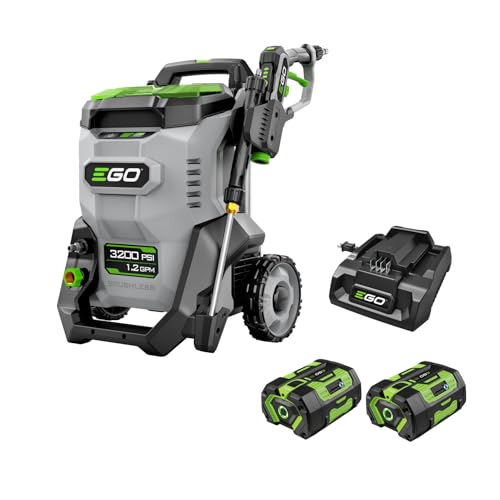
EGO POWER+ HPW3204-2: The Cordless Pick
A cordless kit with ECO, High and Turbo modes and a 40-degree tip. The modes make it easier to stay on the gentle side of a siding wash.
According to EGO, the HPW3204-2 delivers up to 3200 PSI at 1.2 GPM and up to 2.0 GPM at the maximum. It has three modes selected on a display in the wand and comes with 15, 25 and 40 degree nozzles, a foam cannon, a 25 ft hose and a siphon hose. The kit includes two 6.0Ah batteries, and EGO lists up to 60 minutes of runtime on one charge without stating the conditions.
EGO does not say what pressure each mode produces, so we cannot tell you which mode falls inside Ply Gem’s range. Use the lowest mode, the 40-degree tip and the distances above. EGO’s page says “Coming Soon”, so confirm availability. See the EGO HPW3204-2 profile.
Kärcher K 5 FC: The Easiest Fit
A corded 2000 PSI washer that sits inside the 1,500 to 2,400 PSI range with a 40-degree tip and a foam jet for soap.
Kärcher lists 2000 psi at 1.2 gal/min, a 25 ft hose, a 35 ft power cable, 25 and 40 degree Quick Connect nozzles, a detergent nozzle and a 16.9 oz foam jet. It weighs 13.6 lb without accessories. The 2000 PSI figure lands inside Ply Gem’s range, which is why it is the simplest match here. The flow is low, so a two-story house will take time. Kärcher’s page states no warranty figure. See the Kärcher K 5 FC profile.
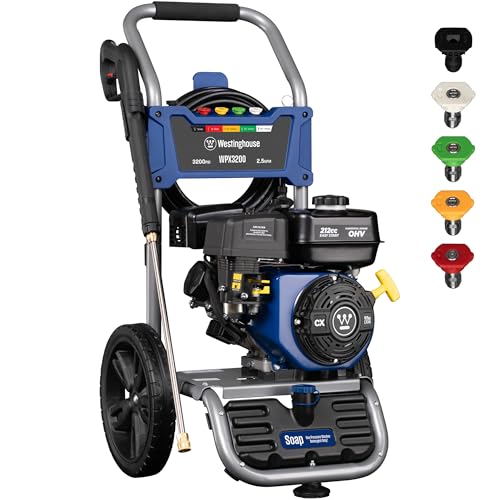
Westinghouse WPX3200: The Gas Option for a Big House
A 3200 PSI gas washer with a soap tank and a 40-degree tip. Faster on a large house, but above Ply Gem's range, so distance matters.
Westinghouse lists a rated 3200 PSI at 2.5 GPM, a 212cc engine with recoil start, a 25 ft hose, a 0.5 gallon soap tank, five nozzles (0, 15, 25, 40 degrees and soap) and a dry weight of 63 lb. The warranty is 3 years limited residential. Its pressure is above Ply Gem’s 2,400 PSI maximum, and the Westinghouse page does not describe an adjustable pressure setting. If you choose it for siding, check your siding maker’s limits first, use only the 40-degree tip and keep to Simpson’s 4 feet or more. Follow the 20-foot exhaust rule. See the Westinghouse WPX3200 profile.
Champion 100580: The Low-Profile Gas Pick
A 3200 PSI gas washer with a Honda engine. Same pressure caveat as the WPX3200, with a lighter 52 lb frame.
Champion lists 3200 PSI at 2.5 GPM, a Honda GCV200 201cc engine with recoil start, an Annovi Reverberi axial cam pump, 0, 25 and 40 degree nozzles plus a soap nozzle, a 25 ft hose and 12 inch wheels. It weighs 52 lb and has no low-oil shut-off. Warranty is 2 years limited. The same limits apply as for the WPX3200: 3200 PSI is above Ply Gem’s maximum, so it needs the 40-degree tip, distance and your siding maker’s approval. See the Champion 100580 profile.
Westinghouse ePX3100: The Light Electric
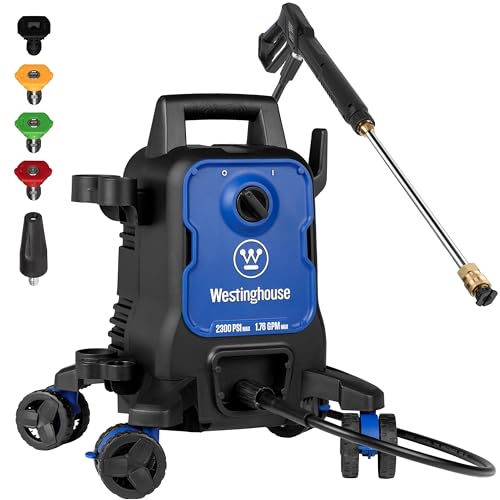
A 19 lb corded washer for small houses and touch-ups. Its pressure lands inside the 1,500 to 2,400 PSI range, but it has no 40-degree tip listed.
Westinghouse lists 1900 PSI rated (2300 max), so the working pressure falls inside Ply Gem’s range. The page lists 0, 15 and 25 degree tips, a turbo tip and soap, with a 20 oz soap tank, a 25 ft hose and a 35 ft cord. The widest tip listed is 25 degrees, not the 40 degrees that Ply Gem names, which is its main drawback for siding. Check whether a 40-degree tip is available before you buy. See the Westinghouse ePX3100 profile.
How to Choose
- Easiest match to the PSI range: the Kärcher K 5 FC.
- No cord and adjustable power: the EGO HPW3204-2.
- A big house and a gas engine: the Westinghouse WPX3200 or Champion 100580, with extra care.
- A small house on a budget: the Westinghouse ePX3100, once you confirm a wide tip.
For washing a vehicle instead, see our guide to pressure washers for cars. Whatever you buy, read the siding maker’s instructions first. None of this is a promise of damage-free results.
Sources
- PEPA: cleaning and maintenance of vinyl siding
- Ply Gem: how to clean your vinyl siding
- Simpson owner’s manual (siding, nozzles and carbon monoxide)
- CDC: Pressure Washer Safety
- EGO POWER+ HPW3204-2 official product page
- Kärcher K 5 FC official product page
- Westinghouse WPX3200 official product page
- Westinghouse ePX3100 official product page
- ePX3100 owner’s manual (Westinghouse)
- Champion 100580 official product page
Frequently asked questions
Can I pressure wash vinyl siding?
The Polymeric Exteriors Products Association (PEPA) says yes, but with caution, and that you should read the instructions for both the siding and the power washer first. It also notes that some siding manufacturers do not recommend power washing, and others limit the pressure and the cleaners you can use. Check your siding maker's guidance and warranty.
What PSI is safe for vinyl siding?
Ply Gem, a siding manufacturer, recommends setting the washer between 1,500 PSI and a maximum of 2,400, with a 40-degree tip. Your siding's maker may set its own limit, so check it. Gas models in our ranking are rated at 3,200 PSI or more, which is above that range.
Which way should I aim the spray?
PEPA says to hold the washer straight at eye level and never aim the stream upward, because that can force water behind the siding panels. Ply Gem gives the same advice. Simpson's manual separately says to hold the wand at a 45-degree angle to the surface, so we suggest following the siding maker's guidance first.
How far from the siding should the nozzle be?
Simpson's manual says to keep the nozzle about 4 feet away from siding to avoid damage. It also says to wash from the bottom up and rinse from the top down, and to avoid driving water up behind the siding.
What nozzle should I use on siding?
Use the white 40-degree tip. Ply Gem names a 40-degree tip, and Simpson's manual lists the white nozzle for painted siding and vinyl. The same manual lists the green nozzle for unpainted siding. It says never to use the red 0-degree tip on wood, and using the wrong nozzle can damage surfaces.
What should I be careful around?
PEPA says to be cautious around windows, doors, electrical wiring and plumbing. The CDC adds that you should never point a pressure washer at people, and that the spray can cause serious wounds that might first appear minor.