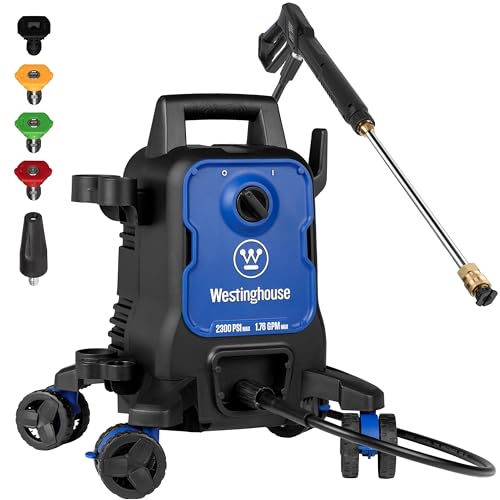
The Westinghouse ePX3100 is a compact electric pressure washer, aimed at homeowners who want something stronger than a hose nozzle and easier to live with than a gas engine. In our ranking of the best pressure washers of 2026 it sits near the entry-level end. This profile explains why, what its specifications say, and who should consider it.
We do not test products ourselves. The facts below come from Westinghouse’s product page for the ePX3100 and from the current ePX3100 owner’s manual on Westinghouse’s site.
The Pressure and Flow Numbers
This is the most important point to understand before buying. Westinghouse separates rated figures from maximum figures:
| Measure | Rated | Max |
|---|
| Pressure (PSI) | 1900 | 2300 |
| Flow (GPM) | 1.24 | 1.76 |
According to Westinghouse, the washer delivers 1900 PSI rated, with a 2300 PSI maximum. The product page gives the rated flow as 1.24 GPM, and the owner’s manual rounds it to 1.2 GPM. Treat 1900 PSI and about 1.2 GPM as the everyday figures, and the 2300 PSI and 1.76 GPM numbers as peaks.
The max GPM is also tied to conditions. The Westinghouse page says the 1.76 GPM figure applies at the lowest pressure. The rated flow, 1.24 GPM, is the more realistic figure for everyday cleaning.
Full Specifications According to Westinghouse
- Power: electric, 120 V AC, 13 amps.
- Hose: 25 ft easy-coil nylon braided hose, with a quick-connect fitting.
- Power cord: 35 ft.
- Wand: an extendable steel wand about 17.5 inches long in its short form.
- Nozzles: 0, 15 and 25 degree tips, a turbo nozzle and a soap nozzle.
- Detergent: a 20 oz onboard tank.
- Pump: axial cam.
- Safety feature: the page lists a “Total Stop System”. We do not describe how it works beyond its name, because the page does not.
- Weight: 19 lb dry (9 kg).
- Dimensions: 13.5 x 14 x 16.5 inches, with four quick-lock wheels.
- Warranty: three years limited residential, one year limited commercial, with lifetime technical support.
What 1.24 GPM Means in Practice
Pressure washer owner’s manuals commonly describe cleaning power as PSI multiplied by GPM. The Simpson manual calls the result “cleaning units”. Using the ePX3100’s rated figures, 1900 x 1.24 comes to about 2,356, a modest number compared with 7,500 for a 3,000 PSI, 2.5 GPM gas machine. The practical effect is time. On a wooden fence or a car, you may not notice. On a large concrete driveway, you will spend longer on each section, and stubborn stains may call for a stronger machine. For a gas model with the capacity for that job, see the Westinghouse WPX3200.
Where It Works Well
- Cars, bikes and boats on a trailer. Moderate pressure and an onboard soap tank make it a sensible tool for vehicle washing.
- Patio furniture, grills and trash cans. The jobs where a hose nozzle is too weak.
- Small decks and patios. The turbo nozzle can handle moss and grime on a small area, though you should keep the tip moving.
- Fences and garage doors. With a wider tip and patience.
- Storage and handling. At 19 lb with wheels, it is easy to move and fits in a closet or garage shelf.
Where It Falls Short
- Big surfaces. A long driveway, a large deck and a whole house are slow work at this flow.
- Reach. You are tied to a 35 ft cord. Extension cords add risk, so follow the instructions in the manual.
- Heavy stains. Deep oil, rust and old paint are beyond what a unit in this class does comfortably.
- Tip selection. The widest tip listed is 25 degrees, so check what arrives in the box before you wash paint or wood.
Using It Safely
The CDC says never to point a pressure washer at yourself or others, and warns that the strong spray can cause serious wounds that might first appear minor. It can also throw objects that injure bystanders. Keep children and pets away from the area while you work.
Choose the tip to match the surface. In the Simpson manual’s nozzle table, the white, 40-degree nozzle is the one for painted or delicate surfaces, including cars, wood, vinyl and painted siding, and the red, 0-degree nozzle is not for wood. The same manual warns that using the wrong nozzle can damage surfaces, and that backing away from the surface lowers the pressure. Westinghouse’s nozzle set for this model includes 0, 15 and 25 degree tips and a turbo nozzle, so check whether a wider tip is in your box before you take it to paint or wood, and read the Westinghouse manual first. We do not recommend the turbo or 0-degree tip on wood, siding or paint.
This is an electric machine, so there is no carbon monoxide risk from an engine. Electricity and water still deserve respect: follow the manual on outlets, cords and connections, and keep the plug and cord connections out of puddles.
Compared with the Other Small Machines
The WORX Hydroshot WG633 is a battery-powered handheld that cleans in a different league. It is easier to carry, but it does not match the flow of a corded machine like the ePX3100. For a similar corded washer with a foam cannon, see the Kärcher K 5 FC. If you want something that can handle larger jobs than a handheld and do not want a gas engine, the ePX3100 is the more capable of the two.
Who Should Buy It
Consider the ePX3100 if you:
- Want an electric washer with no fuel, no oil and no pull cord.
- Have a small yard, a car, a patio or a deck to clean.
- Have limited storage space.
- Want a washer with a three-year residential warranty.
- Are comfortable reading the manual before the first use.
Who Should Look Elsewhere
- Anyone with a large driveway, where a gas washer is faster.
- Owners who need to work far from an outlet.
- Anyone who needs a 40-degree tip for painted or delicate surfaces, since Westinghouse lists none.
Bottom Line
The Westinghouse ePX3100 is a straightforward, corded, entry-level electric pressure washer with a respectable accessory list. Westinghouse rates it at 1900 PSI (2300 PSI max), and its flow is a modest 1.24 GPM rated. It suits small, everyday outdoor jobs. Use the button below to check the current listing on Amazon.
See price on Amazon
Sources