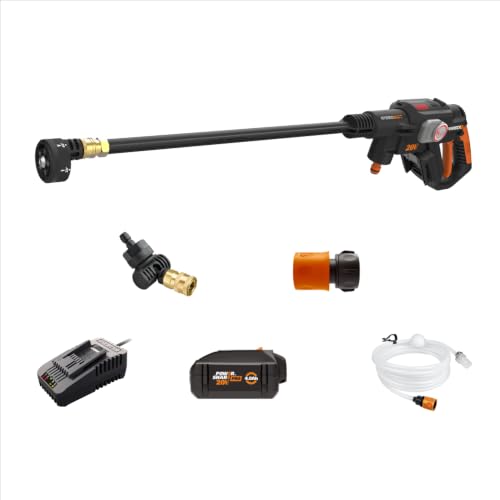
The WORX Nitro Hydroshot WG633 is a small, battery-powered cleaner that sprays water from a pistol-style body. It is the least powerful product we cover in our ranking of the best pressure washers of 2026, and it sits in a different class from every other machine on this site. A shopper searching for a “cordless pressure washer” will often find it, so it deserves a plain explanation of what it is and what it is not.
We do not test products ourselves. This profile is built from the WORX manual for the WG633, which WORX publishes as a PDF, and from general guidance on safe spraying. Where the manual is silent, we say so instead of guessing.
The Short Version
The WG633 is a handheld, 20V brushless power cleaner. According to WORX, its “710 max PSI” is a permissible-pressure figure. That is a real number, but it does not make this tool a replacement for a full pressure washer. The flow is low, and a unit built to be held in one hand does not clean a driveway, a deck or a house at the same rate as a corded electric or gas machine.
Think of it as a step up from a garden hose and spray nozzle. It is meant for small, scattered jobs, and for people who do not want to haul a hose, an extension cord or a gas can.
Specifications According to WORX
These figures come from the WORX manual for the WG633 (titled “20V High flow Hydroshot”):
- Power: a 20V max battery platform (18V nominal) and a brushless motor.
- Permissible pressure: 5.6 MPa, which the manual also gives as 710 PSI. We use only “710 max PSI” for this reason.
- Rated pressure: 3.8 MPa in High mode and 2.5 MPa in Eco mode. The manual states these in megapascals only, so we do not convert them into a headline PSI number.
- Maximum water flow: 220 liters per hour. By our own arithmetic that is a little under 1 gallon per minute, although the manual does not state a gallons-per-minute figure.
- Maximum inlet water pressure: 0.6 MPa.
- Suction height: up to about 4.9 ft (1.5 m).
- Water temperature: a maximum of 104°F (40°C).
- Ingress protection: IPX5.
- Weight: 2.95 lb (1.34 kg) for the bare tool with its lance.
- Standard components: a draw hose, a draw-hose water filter and a float. A foldable water bucket is listed as sold separately.
- Suggested battery and charger: the manual suggests a 4.0 Ah battery and a 2.0 A charger. It does not confirm that either is in the box, so check the listing before you buy.
The manual does not state a warranty. We do not list one.
Why the Numbers Matter
Pressure washers are often compared by PSI and GPM, and the Simpson owner’s manual, for one, describes “cleaning units” as the PSI multiplied by the GPM. Using that rough idea, a tool with flow of around 1 gallon per minute or less has a small ceiling compared with machines rated at 2.5 gallons per minute. The WG633 can look impressive at 710 PSI on a spec line, but the low flow means it rinses away dirt more slowly. That is the main reason we describe it as a power cleaner and not a full pressure washer.
The permissible-pressure figure is also a different thing from a rated, working pressure. According to the WORX manual, the working pressures are the 3.8 MPa and 2.5 MPa values for the two modes. We mention both so you are not surprised if the working numbers are lower than the number in the product name.
How the Draw Hose Changes the Use Case
The most useful feature is the way it takes in water. According to the manual, the WG633 can pull water from a bucket or other source using the included draw hose and filter, after you pre-fill the draw hose. That means you can use it:
- In an apartment or condo with no outdoor spigot.
- On a balcony, a boat dock or a campsite.
- Far from a house, such as at a cabin or a work shed.
- On a car in a parking space, with a bucket of water beside you.
You can also connect it to a water supply, within the maximum inlet pressure the manual lists. With a bucket, you are limited by the bucket and the battery, which suits small jobs.
Good Uses
- Bikes, scooters and strollers. Light mud and dust come off without the force that could strip grease from bearings, though you should still keep the spray away from seals.
- Grills and patio furniture. Rinsing grease and pollen is within reach, especially with a soap or foam attachment if you have one.
- Garden tools and planters. A fast rinse between jobs.
- Car wheels and lower panels. Brake dust and road grime on wheels is a common use.
- Window frames, door mats and trash cans. Jobs that do not need heavy force.
Poor Uses
- Driveways and large patios. The flow is too low to make this efficient. A gas machine is the usual fit for this job.
- House siding. Large wall areas and the control needed for siding are better served by a corded electric or a gas model.
- Deep stains and oil. These usually need more force, more flow and a detergent.
- Anything you need to do in volume. Battery runtime is not stated in the manual, so plan for short sessions.
Safety
A handheld cleaner can still injure someone. The CDC says never to point a pressure washer at yourself or others, and warns that the strong spray can cause serious wounds that might first appear minor. It can also throw objects that strike people nearby. Keep pets and children out of the area, and do not use your hand or foot to hold a part in place while you spray. Follow the WORX manual on how to attach the lance and accessories, and on what to do with the battery.
Because this tool is battery-powered, there is no engine exhaust. The carbon monoxide rules that apply to gas machines do not apply to this model, but the manual’s instructions on water, battery and charger use still do.
Strengths and Limits at a Glance
What it does well:
- It weighs 2.95 lb as a bare tool.
- It does not need an outlet, a gas can or a garden hose.
- It is simple to store, with no engine and no long cord.
- It suits quick jobs that would otherwise mean setting up a larger machine.
Where it falls short:
- The flow is modest, so it is a slow cleaner on large surfaces.
- The 710 figure is a permissible pressure, and the rated pressures in the manual are lower.
- Battery and charger inclusion is not confirmed by the manual.
- The manual does not state a warranty or a runtime.
Who It Suits, and Who Should Skip It
It suits you if you live in an apartment or condo, own a car or a bike and want something between a hose and a full machine, or want a tool for small, mobile cleaning jobs. It is also handy as a second tool for someone who already owns a bigger pressure washer.
Skip it if you plan to clean a driveway, a deck or a two-story house. In that case, an electric model such as the Westinghouse ePX3100 or the Kärcher K 5 FC gives you a corded machine with much more flow for the same sort of home jobs, and a gas model is the step up from there. For a comparison across the whole category, see our pressure washer ranking.
Bottom Line
The WORX Nitro Hydroshot WG633 does one job well: it puts a pressurized spray in a light, cordless body that can drink from a bucket. Understand the 710 max PSI figure as a permissible-pressure limit, expect modest flow, and use it for the small chores it was designed for. If you want to see the current listing and what is included in the box, use the button below.
See price on Amazon
Sources