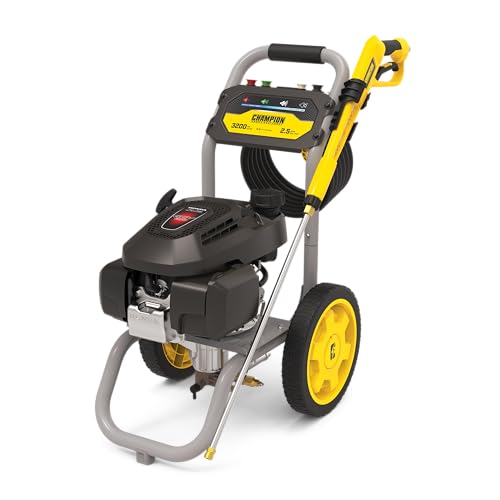
The Champion 100580 is a gas pressure washer built around a Honda GCV200 engine, packaged in a low-profile frame that is lighter and more compact than most machines with the same 3200 PSI and 2.5 GPM numbers. We rank it fourth in our ranking of the best pressure washers of 2026. It does not have the trigger start of the DeWalt or the long commercial warranty of the Simpson, but it does offer a known engine brand, a lower weight and a more modest approach to the job.
We do not test machines ourselves. This profile uses Champion’s official product page and the CDC’s pressure washer safety page. Where Champion does not state something, we say so.
What Champion Says
According to Champion Power Equipment, the 100580 offers:
- Pressure and flow: 3200 PSI at 2.5 GPM.
- Engine: a Honda GCV200, 201cc, with recoil start. Fuel tank capacity is 0.2 gal in the text and 0.24 gal in the spec table. Oil capacity is 0.4 qt, and Champion includes 10W-30 oil and a funnel.
- Pump: an Annovi Reverberi (AR) axial cam pump.
- Hose: a 25 ft high-pressure hose, plus a detergent hose.
- Nozzles: four quick-connect nozzles at 0, 25 and 40 degrees, plus a soap nozzle. There is no 15-degree tip.
- Gun: a comfort-grip trigger gun.
- Frame: a steel frame in a low-profile design, with 12-inch wheels and onboard storage for the hose, gun and wand.
- Size and weight: 26.1 x 17.4 x 31.8 inches and 52 lb.
- Low-oil shut-off: No.
- Emissions: EPA certified and CARB compliant.
- Warranty: 2-year limited, plus free lifetime technical support.
Champion’s page does not list a price, and we do not quote one here. Use the Amazon button to see the current listing.
Low Profile, Lower Weight
At 52 lb, the Champion weighs 25 lb less than the 77 lb Simpson PowerShot PS3228. The low-profile design keeps the machine closer to the ground, and 12-inch wheels are larger than the 10-inch pneumatic tires on the Simpson. That combination matters in three places: lifting it into a trunk or truck bed, rolling it across a lawn or gravel, and storing it on a garage shelf or under a bench. The onboard storage for the hose, gun and wand keeps the loose parts together.
Weight is also a trade-off. A lighter frame and a smaller fuel tank mean a less substantial machine than a commercial-leaning unit. Champion lists a fuel tank of about 0.2 gal, so refuel breaks on a long job are likely. Plan to stop, let the engine cool and refuel outdoors, following the manual.
The Honda GCV200 and the Oil Question
Honda’s GCV200 is a 201cc engine used on many residential pressure washers. On the Champion it has a recoil start, so you will pull a rope. The key fact is on Champion’s spec table: low-oil shut-off is No. Many gas washers add a sensor that stops the engine if the oil gets too low. This one does not, so you need to check the oil level each time before you start. Champion’s 0.4 qt capacity is small, which makes the dipstick check even more important. The box includes 10W-30 oil and a funnel, which gets you started.
Skipping the oil check is the most common way to ruin a small engine, and that cost is not covered by a convenience feature here. If you want that protection, the DeWalt and Simpson both list low-oil shutdown.
Pressure, Flow and Cleaning Units
At 3200 PSI and 2.5 GPM, the Champion works out to 8,000 on the PSI-times-GPM formula that Simpson’s owner’s manual calls cleaning units. That puts it close to the Simpson at 8,250 and the DeWalt at 8,500. Since the three machines are so close on paper, the choice usually comes down to weight, start system, warranty and the little features.
The pump is an Annovi Reverberi axial cam. Champion’s page does not list an unloader or thermal relief valve, so we do not state them here. Check the manual.
Four Nozzles, No 15-Degree
The nozzle set matters for how you use the machine. The Champion comes with 0, 25 and 40 degree nozzles and a soap nozzle. The 0-degree tip is a pinpoint jet for tough spots on hard surfaces, and it can damage wood, siding and car paint, so keep it off those. The 25-degree tip is a general-purpose cleaning tip, and the 40-degree tip is the gentle, wide one for cars, wood and painted siding. Simpson’s manual, which covers a different machine, lists the white 40-degree nozzle for autos, wood and painted siding and warns that the wrong nozzle can damage surfaces.
What is missing is a 15-degree tip, the narrow-fan option that sits between the pinpoint and the general-purpose tip. Some machines in our ranking, such as the Simpson, include one. On a driveway, the 25-degree tip can do most of the work, and a 15-degree tip is not essential. If you want one, check whether Champion sells a compatible nozzle for a quick-connect gun.
Safety Notes for a Gas Machine
The CDC says never to point a pressure washer at yourself or others. It warns that the strong spray can cause serious wounds that might first appear minor, and that the spray can throw objects that strike people nearby.
Because this is a gas machine, carbon monoxide is the second risk. The CDC says small gasoline-powered engines can cause carbon monoxide poisoning, and that you should never use a gasoline-powered washer in an enclosed space or less than 20 feet from any window, door or vent. Run the engine outside, away from the house, and follow Champion’s manual. None of this is a promise of safety.
Where It Works Best
- Mid-size driveways, patios and fences. The 2.5 GPM flow rinses hard surfaces faster than a cordless or small electric machine.
- Owners who need to lift and store it. At 52 lb and with a low profile, it is easier to move than the heavier gas models.
- Honda engine fans on a mid-range budget. The engine brand is the headline feature.
- Owners who value support. Champion lists free lifetime technical support alongside the 2-year limited warranty.
Where It Falls Short
- No low-oil shut-off. The oil check falls to you.
- Only four nozzles. There is no 15-degree tip.
- A shorter warranty. Two years is less than the Simpson’s 5 on the pump and 10 on the frame, and less than the 3 years on the Westinghouse WPX3200.
- Small fuel tank. About 0.2 gal means more stops on a long job.
- Recoil start. If you dislike pull ropes, the DeWalt PressuReady starts with a trigger squeeze, though its battery is sold separately.
Who Should Buy It
The Champion 100580 fits a homeowner who wants a gas washer with a Honda engine, is willing to check the oil before each start, and values a lighter machine that can be moved and stored without help. It suits driveways, siding with the right tip, fences and decks, and it comes with oil and a funnel for a quick start.
Who Should Look Elsewhere
If you want a low-oil shut-off, a trigger start or the longest warranty, another machine in the ranking fits better. If you only wash a car or a small porch, an electric model is quieter and easier to run. If you need the full nozzle set with a 15-degree tip, the Simpson includes one.
Bottom Line
The Champion 100580 is a mid-range gas washer: 3200 PSI, 2.5 GPM, a Honda GCV200, a 52 lb low-profile frame, EPA and CARB certification and a 2-year limited warranty. Its limits are four nozzles, no 15-degree tip and no low-oil shut-off. Use the button below to see the current listing on Amazon, and compare it with the rest of our pressure washer ranking.
See price on Amazon
Sources