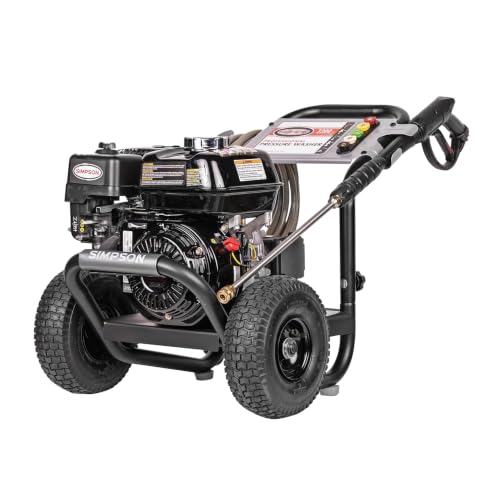
The Simpson PowerShot PS3228 is a gas pressure washer built around a Honda GX200 engine and a triplex pump, the kind of machine that homeowners with a lot of concrete, a big deck or a fleet of vehicles tend to shop for. We rank it first in our ranking of the best pressure washers of 2026. This profile goes through what Simpson publishes about the machine, where the design helps, where it does not, and who should look elsewhere.
We do not test machines ourselves. Everything below comes from Simpson’s own product page and owner’s manual, plus general guidance from the CDC. Where Simpson does not state something, such as the engine’s displacement, we leave it out instead of guessing.
What Simpson Says
According to Simpson, the PS3228 (sold as the PS3228-S online) offers:
- Pressure and flow: 3300 PSI at 2.5 GPM. The page does not label these as “rated” or “maximum” figures.
- Engine: a Honda GX200, listed as 49-state compliant, with low-oil shutdown.
- Pump: an AAA triplex pump with an integrated unloader and a thermal relief valve.
- Hose: a MorFlex hose, 5/16 inch by 25 feet.
- Gun and wand: a rear-load spray gun with an M22 connection and a 16-inch quick-connect lance.
- Nozzles: five quick-connect tips at 0, 15, 25 and 40 degrees, plus a soap tip.
- Wheels and frame: 10-inch pneumatic tires on a welded, powder-coated steel frame.
- Size and weight: 21 x 24 x 34 inches (length, width, height) and 77 lb.
- Warranty: 3-year limited commercial on the engine, 5-year limited commercial on the pump, 10-year limited commercial on the frame, and 90 days on accessories.
- Availability: a 49-state model, not for sale in California.
Simpson’s page lists the numbers but not the Honda engine’s displacement, the fuel tank size or the oil capacity, so check the owner’s manual for those before you buy fuel and oil.
What 3300 PSI at 2.5 GPM Means
Pressure (PSI) is how hard the water hits the surface. Flow (GPM) is how much water arrives each minute. Simpson’s manual describes “cleaning units” as the PSI multiplied by the GPM, and for the PS3228 that is 3300 x 2.5, or 8,250. A larger number generally means faster work on flat, hard surfaces such as concrete, because the machine both loosens dirt and rinses it away. It is not a measure of how gentle or safe the machine is on a given surface. A 3300 PSI washer with the wrong tip can scar wood, strip paint or etch soft masonry in a single pass.
Compare that with the cordless EGO POWER+ HPW3204-2, which EGO rates at up to 3200 PSI but only 1.2 GPM at that pressure. The PSI numbers look close, yet a gas machine at 2.5 GPM moves roughly twice as much water, and that matters when you are rinsing a 1,000 square foot driveway.
The Pump and Engine
Two parts decide how long a gas washer lasts: the engine and the pump. The Honda GX200 is a familiar engine in this class, and Simpson pairs it with low-oil shutdown, which stops the engine if the oil level drops too far instead of letting it run dry. The pump is an AAA triplex design, which Simpson describes with an integrated unloader and thermal relief valve. The unloader sends water back around the pump when you release the trigger. The thermal relief valve protects the pump if it heats up while the trigger is held closed. Simpson backs the pump for five years under its commercial warranty terms and the frame for ten.
The warranty is worth reading in full before you buy. Simpson describes it as “limited commercial” coverage, and the terms, exclusions and registration steps are in the manual and on Simpson’s site, not in the table above.
Nozzles and What They Are For
The quick-connect tips are color coded. From Simpson’s owner’s manual:
- Red: spot cleaning of hard, unpainted surfaces such as unpainted metal and concrete. The manual says not to use it on wood.
- Yellow: intense cleaning of unpainted surfaces, including grills, driveways, concrete and brick walkways, and unpainted brick and stucco.
- Green: the standard nozzle for most work: yard tools, sidewalks, lawn furniture, unpainted siding, stucco, gutters, eaves, concrete and brick.
- White: painted or delicate surfaces, including autos, trucks, RVs, boats, wood, painted brick, painted stucco, vinyl and painted siding. The manual calls this the 40-degree nozzle and says it produces a lower-pressure, wider spray.
- Black: the soap nozzle for applying cleaning solutions. The manual says to verify that any cleaning solution is compatible with the surface.
The manual’s table gives the colors and uses but not the spray angle for red, yellow and green. Simpson’s product page lists the tips as 0, 15, 25 and 40 degrees plus soap, so those colors usually map in that order, but confirm against the markings on your tips.
The simple rule is to never put the narrow red tip on wood, siding or a car. Simpson’s manual warns that the spray can damage plants and surfaces such as wood, glass, automobile paint, striping and trim, and that using the wrong nozzle can damage surfaces. Standing farther back also lowers the pressure that reaches the surface, so start at a distance and move closer only as needed.
Safety Notes for a Gas Machine
The CDC says never to point a pressure washer at yourself or others, and warns that the strong spray can cause serious wounds that might first appear minor. It also notes that the spray can throw objects that strike and injure people nearby. Simpson’s manual says the same in its own words: never point the wand at people or animals, and use personal protective equipment because light or unsecured objects can become hazardous projectiles.
The second issue is carbon monoxide. Simpson’s manual says engine exhaust contains carbon monoxide, an odorless, colorless, poisonous gas, and that running an engine indoors will kill you in minutes. It says never to use the product inside a house, garage or any other enclosure, even if doors and windows are open, and to run the engine outside at least 20 feet from windows, doors and vents. The CDC gives the same 20-foot distance for gasoline-powered washers. These are minimums from the sources, not a guarantee of safety, so read the whole manual before the first start.
Where It Works Best
- Large concrete areas. A long driveway, a patio and a walkway are where 2.5 GPM saves time compared with a smaller electric machine. If you do this often, a surface cleaner attachment is worth a look; check that it fits the machine’s connections first.
- Decks and fences with the right tip. Wood needs the white or another wide tip held back from the surface. Practice on a hidden spot.
- Equipment, trucks and trailers. The white 40-degree tip is listed for autos, trucks, RVs and boats, though a car’s paint is better treated with caution and distance.
- Owners who want a warranty with weight. Simpson lists a 5-year pump and 10-year frame term, which is a longer stated commitment than the 2-year Champion or the 3-year Westinghouse terms in our ranking.
Where It Falls Short
- Weight and bulk. At 77 lb with 10-inch pneumatic tires, it rolls well on a driveway but is awkward to lift into a truck bed alone, and stairs are a two-person job.
- Gas upkeep. You will handle fuel, oil, a winter storage routine and an engine that needs care. If you do not want that, look at a cordless model such as the EGO HPW3204-2.
- Hose length. A 25 ft hose limits reach from the machine. You can move the washer, but there is no onboard hose reel listed.
- Not for California. The page says this version cannot be sold there.
- Noise. Like any 3300 PSI gas engine, it is loud. Plan for hearing protection and for neighbors’ schedules.
Simpson PS3228 vs. the Alternatives
The DeWalt DXPW3400PRNB-S PressuReady offers 3400 PSI at 2.5 GPM with a battery-assisted start, so there is no recoil rope or choke, and a steel-braided hose. The trade-off is that the battery and charger are sold separately, and DeWalt’s page does not state weight or warranty. The Simpson counters with a Honda engine, a stated 77 lb weight and a published warranty. The Champion 100580 is a 3200 PSI machine with a Honda GCV200 engine and a lower profile at 52 lb, which makes it easier to carry, but with four nozzles and a 2-year warranty.
Who Should Buy It
The PS3228 suits a homeowner with a lot of hard surface to clean, comfort with small-engine maintenance, and storage space for a wheeled gas machine. It also suits someone who values a long, published warranty and a known engine brand. Anyone who mostly rinses cars, patio furniture and a small porch will find it more than they need.
Who Should Look Elsewhere
If you live in California, this version is not available. If you want quiet, low-maintenance cleaning of a small area, an electric or cordless model is a better fit. If weight is the main concern, the lighter Champion is the closer match among the gas models we cover.
Bottom Line
The Simpson PowerShot PS3228 is a premium, commercial-leaning gas washer: 3300 PSI, 2.5 GPM, a Honda GX200 with low-oil shutdown, a triplex pump with unloader and thermal relief, and warranty terms that run 3, 5 and 10 years on the major parts. Its costs are weight, noise, upkeep and its California exclusion. Use the button below to see the current listing on Amazon, and compare it with the rest in our pressure washer ranking.
See price on Amazon
Sources