We earn a commission if you buy through our links, at no extra cost to you.
Best Pressure Washer for Cars (2026)
How to pick a pressure washer for washing a car: moderate pressure, a wide 40-degree tip, a foam cannon and runoff rules, plus four electric and cordless models.
At a glance
For washing a car, use an electric or cordless washer with a wide 40-degree tip. The Kärcher K 5 FC ships with a foam cannon, the EGO HPW3204-2 runs cordless, and the Westinghouse ePX3100 is a lighter-duty corded option. Gas machines are more than paint needs.
A pressure washer can make washing a car faster, and it can also strip wax, chip old paint and scar trim if you aim it badly. The machine matters less than how you set it up. A moderate-pressure washer, a wide tip, some distance from the paint and a good soap will do more for a car than a bigger engine. This guide covers the setup first, then four models from our ranking of the best pressure washers of 2026 that fit the job.
We do not test products ourselves. The specifications come from the manufacturers’ own pages and manuals, and the washing advice comes from Kärcher, Simpson, the CDC and the EPA. Where a maker leaves a number out, we say so.
Why Gas Machines Are Overkill for Paint
The four gas models in our ranking, the Simpson PowerShot PS3228, the DeWalt PressuReady, the Champion 100580 and the Westinghouse WPX3200, are rated from 3,200 to 3,400 PSI at 2.5 GPM. They are built for concrete, brick and big decks. On a car they give you more force than you can safely use, and they add a second problem: engine exhaust.
Simpson’s owner’s manual warns that high-pressure spray can damage “automobile paint, auto striping and trim”. It also says engine exhaust contains carbon monoxide and that you should never run the engine inside a house, garage or any enclosure, even with doors and windows open, and should keep it at least 20 feet from windows, doors and vents. The CDC page on pressure washer safety says the same thing about 20 feet. A car wash often happens next to a garage door, which is a poor place for a gas engine.
If you already own a gas machine, you can use it on a car with the widest tip and plenty of distance. If you are buying for the car, choose electric or cordless.
What Matters When You Wash a Car
Pressure, Flow and Cleaning Units
Specs list pressure in PSI and flow in GPM. Simpson’s manual explains that “cleaning units” are calculated by multiplying PSI by GPM. For cars you want enough flow to rinse dirt and soap away, and pressure you can tame with the nozzle. A 2000 PSI electric washer at 1.2 GPM works out to a modest number of cleaning units. That is a feature on paint, not a flaw.
The Right Tip
Nozzle choice is the single biggest factor. According to Simpson’s manual, the white 40-degree nozzle is for cleaning painted or delicate surfaces, including auto, truck, RV, marine and wood, and “produces a lower pressure, wider width spray”. The manual also says using the incorrect nozzle can damage surfaces, and that the red tip is for hard, unpainted surfaces. Never put the red 0-degree tip on paint, wood or siding.
Distance from the Paint
Simpson’s manual says that the further you hold the nozzle from the surface, the lower the pressure. Kärcher’s car-washing page gives a starting distance: work with the flat-jet nozzle about 6 inches (15 cm) from the car’s surface and about 12 inches (30 cm) from the tires. Those figures are Kärcher’s own, and Kärcher writes them in metric units. If you are unsure, begin farther back and move in only if the dirt needs it.
Order of Work
Kärcher’s page gives a simple sequence:
- Loosen coarse dirt first with the pressure washer and the flat-jet nozzle, which helps prevent scratching.
- Apply foam cleaner. Do not create mountains of foam, because it may slide off before it has time to soak in.
- Wash the car from the bottom up.
- Rinse.
Foam Cannons and Soap
Kärcher says foam cleaner forms a dense, longer-lasting foam and is particularly easy to apply with a foam nozzle. Simpson’s manual says never to use bleach and to verify that any cleaning solution is compatible with the surface. Use a car-wash soap made for paint and follow its label.
Runoff and Storm Drains
The EPA’s stormwater guidance for vehicle washing says outdoor car washing can send detergent-rich water into storm drains, and that this water may contain nutrients, metals and hydrocarbons. Storm drains lead directly to local waterways, not to treatment facilities. The EPA suggests using biodegradable, phosphate-free, water-based detergents, limiting the amount of detergent, and washing in a driveway or yard, not in the street. It also suggests car wash kits that protect nearby storm drains. Some local ordinances prohibit this kind of runoff, so check yours. The EPA frames these as recommended practices, not a federal rule for home washing.
Safety with the Spray
The CDC says never to point a pressure washer at yourself or others, that the spray can cause serious wounds that might first appear minor, and that it can throw objects that injure people nearby. Keep kids and pets away while you wash, and keep the spray off your own feet and hands.
Four Models for Washing a Car
Kärcher K 5 FC: The Foam Cannon Pick
A light, corded 2000 PSI washer that ships with a 16.9 oz foam jet and a 40-degree tip. The most car-focused model on this list.
According to Kärcher, the K 5 FC runs on 120 V, delivers 2000 psi at 1.2 gal/min and weighs 13.6 lb without accessories. It includes a 16.9 oz foam jet, a 25 ft high-pressure hose, a 35 ft power cable, Quick Connect nozzles at 25 and 40 degrees, a detergent nozzle and a turbo nozzle. It also has an aluminum pump, a water filter and automatic pump shutdown when you release the trigger.
Kärcher markets the foam cannon for vehicles, and the machine is the only one on this page whose name points at car care. Keep the turbo nozzle off the paint: Kärcher says it is meant for stripping old paint or stains from fences and decks. The page does not state a warranty figure. See the full Kärcher K 5 FC profile.
EGO POWER+ HPW3204-2: The Cordless Pick
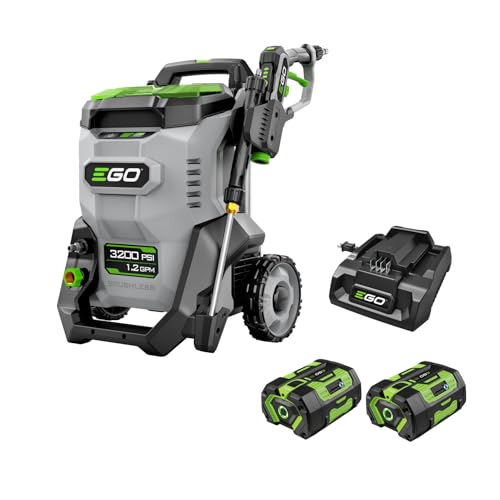
A battery-powered washer with no cord to drag across the driveway, three power modes and a foam cannon. A strong fit if you wash away from an outlet.
EGO lists this kit with two 6.0Ah batteries and a 320W charger. According to EGO, it delivers up to 3200 PSI at 1.2 GPM, with up to 2.0 GPM at the maximum, and has ECO, High and Turbo modes chosen on a display in the wand. Accessories include 15, 25 and 40 degree nozzles, a turbo nozzle, a rinse nozzle, a foam cannon, a filter and a siphon hose for fresh-water sources. EGO claims up to 60 minutes of runtime on one charge but does not state the conditions.
That much pressure is more than paint needs, so the modes and the 40-degree tip are what make it car-friendly. Start in ECO. Note that EGO’s own page says “Coming Soon”, so confirm current availability before you buy. See the EGO HPW3204-2 profile.
Westinghouse ePX3100: The Lighter-Duty Corded Pick
A compact, 19 lb corded washer with a 20 oz soap tank and a turbo tip. A simple way to wash a car from a standard outlet.
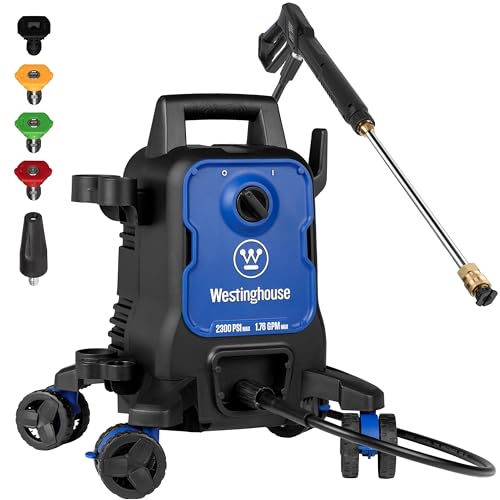
Westinghouse’s product page lists 1900 rated PSI (2300 max) and 1.24 rated GPM (1.76 max). Treat 1900 PSI as the everyday figure and 2300 PSI as the peak. It runs on 13 A, has a 25 ft hose and a 35 ft power cord, and weighs 19 lb dry. Tips are 0, 15 and 25 degrees, plus turbo and soap, according to the page, so there is no 40-degree tip listed. Use the soap nozzle for applying detergent and the widest remaining tip, the 25-degree one, from a good distance.
That missing 40-degree tip is the main reason it ranks below the Kärcher for this job. Westinghouse backs it with a 3-year limited residential warranty. See the Westinghouse ePX3100 profile.
WORX Hydroshot WG633: The Bucket-Fed Pick
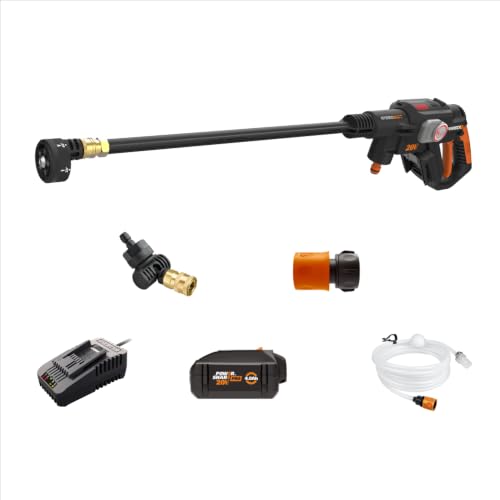
A handheld 20V cleaner that draws water from a bucket. For apartment dwellers and quick touch-ups, not full washes.
The WORX manual lists a 20V max brushless tool, a permissible pressure of 710 PSI, rated pressures of 3.8 MPa in High and 2.5 MPa in Eco, and a maximum flow of 220 liters per hour (a little under 1 gallon per minute by our arithmetic). The bare tool weighs 2.95 lb. A draw hose, a filter and a float are standard components, and a foldable bucket is sold separately, so you can wash with no outdoor spigot.
This is a power cleaner, not a full pressure washer. Its low flow suits wheels, bumpers and lower panels better than a whole-car wash. See the WORX Hydroshot WG633 profile.
Which One Should You Choose?
- Foam and a wide tip, plugged in: the Kärcher K 5 FC.
- No outlet nearby: the EGO HPW3204-2, with the battery runtime caveat above.
- A simple corded unit: the Westinghouse ePX3100, keeping in mind the missing 40-degree tip.
- No spigot at all: the WORX WG633 for light work.
For bigger jobs like concrete, our other guides cover gas machines. Whatever you buy, read the owner’s manual for the nozzle labels before you aim at paint.
Sources
- Kärcher: car washing with a pressure washer
- Kärcher K 5 FC official product page
- EGO POWER+ HPW3204-2 official product page
- Westinghouse ePX3100 official product page
- ePX3100 owner’s manual (Westinghouse)
- WORX WG633 user manual (PDF)
- Simpson owner’s manual (nozzles, PSI, GPM and safety)
- EPA: Stormwater BMP, Vehicle Maintenance and Washing (PDF)
- CDC: Pressure Washer Safety
Frequently asked questions
What PSI is right for washing a car?
Manufacturers do not publish a single safe PSI for paint, so we do not give one. What they do say is to use a wide nozzle and stay back from the surface. Simpson's manual lists the white 40-degree tip for autos and trucks and says the further the nozzle is from the surface, the lower the pressure. A 2000 PSI electric washer with a 40-degree tip is a common starting point.
Which nozzle should I use on my car?
Use the widest tip your washer comes with. That is the 40-degree tip on the Kärcher K 5 FC and the EGO HPW3204-2; Westinghouse lists 0, 15 and 25 degree tips plus turbo and soap on the ePX3100, so its 25-degree tip is the widest. According to Simpson's manual, the white 40-degree tip is the one for autos, trucks, RVs and marine use, and the red 0-degree tip is for hard, unpainted surfaces and should never go on wood. Never use it on paint.
How close can I hold the nozzle to the paint?
Kärcher's car-washing page says to work with the flat-jet nozzle at about 6 inches (15 cm) from the car's surface and about 12 inches (30 cm) from the tires. Those figures are Kärcher's, written for its own machines, so read your own manual too.
Do I need a foam cannon?
No, but it helps. Kärcher says foam cleaner forms a dense, longer-lasting foam that is easiest to apply with a foam nozzle, and that you should not build up mountains of it. The Kärcher K 5 FC and the EGO HPW3204-2 both list a foam cannon. The Westinghouse ePX3100 and the WORX use a soap tank or nozzle instead.
Can I wash my car with a pressure washer if I live in an apartment?
Possibly. The WORX Hydroshot WG633 can draw water from a bucket through its draw hose, according to the WORX manual, so it works without a spigot. It has low flow and is for light jobs. Check your building and local rules before washing a car on shared property.
Where does the soapy water go?
The EPA says outdoor car washing can send detergent-rich water into storm drains, which lead directly to local waterways and not to treatment facilities. It suggests biodegradable, phosphate-free detergent, using less of it, and washing on a driveway or yard instead of the street. Some local ordinances prohibit it.