We earn a commission if you buy through our links, at no extra cost to you.
Best Pressure Washer for a Concrete Driveway (2026)
What a concrete driveway needs from a pressure washer: PSI, flow, tips, a surface cleaner and runoff care, plus four gas models and one electric for small slabs.
At a glance
For a large concrete driveway, choose a gas washer with 3200 PSI or more and 2.5 GPM. The Simpson PowerShot PS3228 is the top pick, the DeWalt DXPW3400PRNB-S PressuReady adds trigger-squeeze starting, and the Champion 100580 is the lighter option. Run gas engines outdoors only.
A concrete driveway is one of the toughest jobs for a pressure washer, and not because the concrete is fragile. It is because of the size. A typical driveway is hundreds of square feet of flat slab, and the difference between a machine that takes one hour and one that takes four is flow, not just pressure. This guide explains what to look for, how the makers say to work, and which models from our ranking of the best pressure washers of 2026 fit the job. The facts come from the manufacturers’ own pages and manuals. We do not test machines ourselves, and where a maker leaves a detail out, we say so.
Why Flow Matters as Much as PSI
Pressure (PSI) is how hard the water hits the surface. Flow (GPM) is how much water arrives each minute. Simpson’s manual describes cleaning units as PSI multiplied by GPM. By that arithmetic, a gas washer at 3300 PSI and 2.5 GPM is 8,250 cleaning units, and a 2000 PSI electric washer at 1.2 GPM is 2,400. The units are our calculation from published figures, not something the makers print, but they show why gas machines pull ahead on big slabs: more water means each pass lifts and carries away more dirt.
That is also why the cordless EGO POWER+ HPW3204-2, at up to 3200 PSI but 1.2 GPM, is not in the main picks below. It makes strong pressure with modest flow, which suits smaller jobs better than a long driveway. Our EGO HPW3204-2 profile covers where it fits.
Gas or Electric for Concrete
For a full-size driveway, we suggest gas. The four gas models below all list 2.5 GPM and between 3200 and 3400 PSI. Electric washers are lighter and need no engine upkeep, but the electrics we cover top out at 1.2 to 1.76 GPM and 2000-plus PSI, which turns a driveway into an afternoon. They make sense for a small patio, a walkway or a single-car pad.
The trade-off with gas is carbon monoxide. Simpson’s manual says engine exhaust contains carbon monoxide, that running an engine indoors can kill in minutes, and that you should never use it inside a house, garage or any other enclosure, even with doors and windows open. It says to run the engine outside at least 20 feet from windows, doors and vents. The CDC gives the same 20-foot distance and warns that small gasoline engines can cause carbon monoxide poisoning. That rule matters here because people often wash the garage floor and apron together.
Tips and Technique
Pick the right tip. Simpson’s manual lists the yellow tip for intense cleaning of unpainted surfaces, including driveways and concrete and brick walkways, and the green tip as the standard nozzle, including for concrete. It lists the red tip for spot cleaning hard, unpainted surfaces such as concrete, and says not to use it on wood. The manual warns that using the incorrect nozzle can damage surfaces, and that the further you hold the nozzle from the surface, the lower the pressure. The manual’s table gives colors and uses rather than degrees, and the tips included vary by washer, so check your own manual.
Sweep, pre-treat, then clean. Kärcher’s driveway guide describes the method: sweep off loose debris, apply a detergent and let it dwell for several minutes, make overlapping passes with a surface cleaner, then rinse. Simpson’s manual adds a practical point for soap: work in small areas so the soap does not dry. Kärcher’s guide is written for Australian homeowners and uses metric units, so we take the technique and not the specifications.
Use a surface cleaner. Kärcher calls a pressure washer combined with a surface cleaner attachment the most effective method for a driveway. The attachment covers a wide strip with one pass, and it avoids the stripes a bare wand tends to leave. Before you buy one, check that your washer’s connection, pressure and flow fit the attachment; the Simpson and Westinghouse models below use M22 connections for the gun, but the surface cleaner’s own requirements decide.
Work with the slope. Kärcher’s pavers page says always to work with the slope, so the dirty water runs off and does not spread over the part you have already cleaned. It also warns that the water jet can quickly damage concrete or terracotta pavers, which is a reason to keep the tip moving and the wand at a steady distance. That page covers pavers, not poured concrete, so treat it as general technique.
Oil stains. For oil on pavers, Kärcher’s page suggests absorbent material such as cat litter or sawdust, swept away, or a patio and deck cleaner concentrate. We did not find a manufacturer or extension source on degreasers for poured concrete, so follow the label of any cleaner you buy.
Runoff, Soap and Your Storm Drain
The EPA’s guidance on vehicle washing says outdoor washing can send detergent-rich water into storm drains, which lead directly to local waterways, not to treatment facilities. It recommends biodegradable, phosphate-free, water-based detergents, limiting the amount of detergent, and washing on a driveway or yard rather than in the street. That guidance is about washing vehicles, but the same logic applies when you spread soap across a driveway that slopes toward the street. Some local ordinances prohibit discharge to storm drains, so check yours.
Safety on the Job
The CDC says never to point a pressure washer at yourself or others, that the spray can cause serious wounds that might first appear minor, and that it can throw objects that injure people nearby. Keep children and pets off the slab while you work. Simpson’s manual also says to use personal protective equipment because light or unsecured objects can become hazardous projectiles. Read your owner’s manual before first use.
The Models Worth a Look
Simpson PowerShot PS3228: The Top Pick
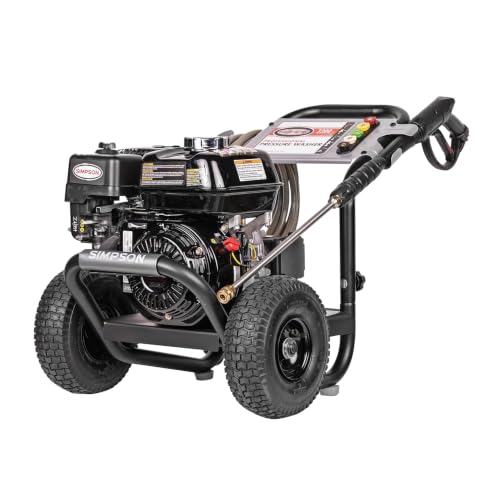
A 3300 PSI, 2.5 GPM gas washer with a Honda GX200 engine and an AAA triplex pump. The strongest fit here for a large slab or several jobs a season.
According to Simpson, the PS3228 has a Honda GX200 engine with low-oil shutdown, a triplex pump with an unloader and thermal relief valve, a 5/16 inch by 25 ft hose and five quick-connect tips. It weighs 77 lb and rides on 10 inch pneumatic tires. The warranty is 3 years on the engine, 5 on the pump and 10 on the frame under limited commercial terms. The 49-state version is not for sale in California. See the Simpson PowerShot PS3228 profile for the full specs.
DeWalt DXPW3400PRNB-S PressuReady: The Easy-Start Pick
A 3400 PSI, 2.5 GPM gas washer that starts when you squeeze the trigger, for owners who want to skip the recoil rope. The DeWalt battery is sold separately.
DeWalt lists a 208cc engine with low-oil shutdown, an aluminum axial cam pump, a 25 ft steel-braided hose and an LED diagnostic panel. The unit shuts off after a few seconds of inactivity, which suits a long driveway where you stop to move the surface cleaner. The tool-only version needs a DEWALT 20V MAX or FLEXVOLT battery, and DeWalt’s page does not state a weight or warranty. Details are in our DeWalt PressuReady profile.
Champion 100580: The Lighter Gas Pick
A 3200 PSI, 2.5 GPM gas washer at 52 lb with 12 inch wheels, for owners who want Honda power in a more compact frame.
According to Champion, it has a 201cc Honda GCV200 engine, an axial cam pump, four quick-connect nozzles (0, 25, 40 degrees and soap) and a 2-year limited warranty. There is no low-oil shutoff, so check the oil before each start. The Champion 100580 profile has more.
Westinghouse WPX3200: The Gas Pick with a Soap Tank
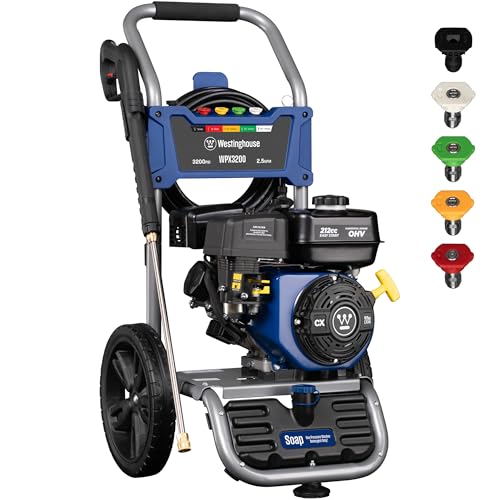
A 3200 PSI, 2.5 GPM rated gas washer with an onboard 0.5 gallon soap tank, useful when you pre-treat a whole slab.
Westinghouse lists a 212cc OHV engine, a 3-piston axial cam pump, five nozzles, 12 inch never-flat wheels and a 63 lb dry weight, with a 3-year limited residential warranty. There is no low-oil shutdown. Westinghouse’s manual warns that using the product indoors can kill you in minutes, so keep it outside. See the Westinghouse WPX3200 profile.
Kärcher K 5 FC: For a Small Patio or Walkway
A light 120 V electric washer at 2000 PSI and 1.2 GPM, for a small patio, walkway or single-car pad rather than a full driveway.
Kärcher says it suits homes, driveways and other outdoor areas, and it weighs 13.6 lb without accessories. With 1.2 GPM, expect a long job on a big slab. The Kärcher K 5 FC profile lists its nozzles and cord length.
Which One Should You Choose?
For a full driveway, start with the Simpson PS3228 if you want a commercial-grade warranty and a triplex pump, or the DeWalt if the easy start matters most. The Champion is the lighter way to get Honda power. The Westinghouse adds a soap tank and a residential warranty. For a small slab, the Kärcher is easier to store and handle. Our full ranking compares all eight models side by side.
Sources
- Simpson: PowerShot PS3228 (official product page)
- Simpson: owner’s manual
- DeWalt: DXPW3400PRNB-S PressuReady (official product page)
- Champion Power Equipment: 100580 3200 PSI pressure washer (official product page)
- Westinghouse: WPX3200 pressure washer (official product page)
- Westinghouse: WPX2700 / WPX3200 / WPX3400 user manual
- Kärcher: K 5 FC (official US product page)
- Kärcher Australia: how to clean your driveway, patio and pavers
- Kärcher US: cleaning pavers
- EPA: Stormwater best management practice, vehicle maintenance and washing (PDF)
- CDC: Pressure Washer Safety
Frequently asked questions
How much PSI do I need to clean a concrete driveway?
There is no single official number, but the gas models in this guide offer 3200 to 3400 PSI at 2.5 GPM, which is what we suggest for a full driveway. A 2000 PSI electric model works on a small slab or patio but takes much longer because its flow is only 1.2 GPM.
Which nozzle should I use on concrete?
Simpson's manual lists the yellow tip for intense cleaning of driveways and concrete and brick walkways, and the green tip as the standard nozzle for most jobs including concrete. The red tip is for spot cleaning hard, unpainted surfaces such as concrete and is not for wood. Check your own washer's manual, because the tips included vary by model.
Do I need a surface cleaner attachment?
Kärcher says the most effective method for cleaning a driveway is a pressure washer combined with a surface cleaner attachment. A surface cleaner spreads the spray over a wide disc, so you get even passes. Check that your washer's pressure, flow and connection fit the attachment before you buy.
How do I get oil off a concrete driveway?
Kärcher's pavers page suggests absorbent material such as cat litter or sawdust, swept away, for oil on pavers, or a patio and deck cleaner concentrate. That page covers pavers rather than poured concrete, so read the label of any cleaner you use.
Where does the wash water go?
On most driveways it runs to the street and a storm drain. The EPA says outdoor car washing can send detergent-rich water into storm drains that lead to local waterways, not treatment plants, and suggests limiting detergent and using phosphate-free products. Driveway washing raises the same concern, so keep soap use low.
Can I run a gas pressure washer in the garage to rinse the floor?
No. Simpson's manual says never to use the product inside a house, garage or any enclosure, even with doors and windows open, and to run it outside at least 20 feet from windows, doors and vents. The CDC gives the same 20-foot distance.